
Lesley McDowell wanted to show all the consequences of women’s sexuality in her novel, Clairmont — the tragic and the happy. There was plenty of both in the Shelley-Godwin-Byron circle that shaped her protagonist Claire Clairmont’s life. And female sexual desire needs to be reflected in historical fiction, Lesley says.
In a letter to her friend, Jane Williams, from a frozen Moscow in 1826, Claire Clairmont wrote that she had been “the victim of a happy passion… it was fleeting and mine only lasted 10 minutes but these 10 minutes have discomposed the rest of my life.”
The passion Claire was referring to was her affair with the poet Lord Byron, which took place in 1816, when she was just 18 years old. Two years before, she had accompanied her step-sister Mary Godwin to the Continent, when Mary eloped with the married poet, Percy Bysshe Shelley. Mary’s “happy passion” could be said to have “discomposed” the rest of her life, too, though hers lasted more than 10 minutes.

Sexual passion for women in an era before they controlled their own contraception, had true financial autonomy, or even enjoyed full intellectual freedom, was not only risky, it could prove fatal.
Unsurprisingly then, it came with warnings from the Regency era’s literary star, Jane Austen, as her 1813 novel Pride and Prejudice demonstrated through the figure of sexually-defiant Lydia Bennet.
Her elopement with Mr Wickham could only end badly, Austen tells us: “They were always moving from place to place in quest of a cheap situation, and always spending more than they ought. His affection for her soon sunk into indifference; her’s [sic] lasted a little longer…”
Women who follow their sexual desires will end up poor, and despised, even by their husbands, Austen says, and so it’s important that she shows Lydia as the exception in her family. None of her four sisters elope, but instead contain their sexual desires within the social rules of courtship and a proposal, and the acquiring of a father’s permission to marry.
In this respect, both Claire Clairmont and Mary Godwin Shelley could be considered a pair of Lydia Bennets. They were both women who defied social norms, earning the sorrow (“a cheap situation”, “indifference”) that threatened their defiance.
But were Claire and Mary really exceptions to the rule, like Austen wants us to see Lydia? For if they weren’t, we really should be exploring their “happy passions” quite differently in fiction today.
In 1811 — the year that Austen published Sense and Sensibility, with another warning for young women as her heroine Marianne Dashwood is jilted by her lover, Willoughby – 16-year-old Harriet Westbrook eloped with Percy Bysshe Shelley, three years before Mary Godwin did the same.
Following her sexual passions took her on a journey to marriage and two children, but it also took her to tragedy: at the end of 1816, Harriet drowned herself in the Serpentine. She was heavily pregnant at the time.
Perhaps Austen’s warnings are right. Mary Godwin’s mother, Mary Wollstonecraft, had followed her own “happy passion”, the adventurer, Gilbert Imlay, giving birth to his daughter, Frances, during the French Revolution.

Claire Clairmont’s mother, Mary-Jane Vial, had two children out of wedlock and by two different men – Claire’s father was the baronet, Sir John Lethbridge. Mary Wollstonecraft attempted suicide twice after Imlay deserted her; not long after the birth of Claire, Mary-Jane Vial ended up in debtor’s prison.
Life for women who followed their passions could be hard. Certainly Claire and Mary, as part of Shelley’s household, often moved house without settling bills, so precarious was Shelley’s income, and Claire had little say in the upbringing of Allegra, her daughter by Byron, who tragically died at the age of five.
Mary herself lost two children, Clara and William, in infancy, before her husband drowned off the coast of Italy, leaving her a widow.
Austen would tell us that these are the inevitable tragic consequences for women who follow their passions. And yet, Jane Williams, the widow of Edward Williams, who also drowned with Shelley on that boat journey, went on to live with Shelley’s friend, Thomas Jefferson Hogg, and give birth to two children out of wedlock.
The Shelleys’ children’s nurse during the years 1816–1819, Louise Duvillard, was an unmarried mother when she came to work for them; later in her life, Claire’s niece Paula had an illegitimate daughter, Georgiana, who Claire offered to adopt.

So not all the consequences of sexual passion in the Shelley-Godwin-Byron circle were tragic ones. And both Mary Wollstonecraft and Mary-Jane Vial went on to find happiness with William Godwin; Mary-Jane Vial launched a children’s book publishing business, and at one time was the only female publisher listed in London.
Claire’s sexual independence was part of her financial independence, as she worked in Russia as a governess, or later lived in Paris, supplementing her income by tutoring. Mary Shelley earned a living as an author.
Both women had further sexual experiences in their lives; “happy passions” did not end with the deaths of Shelley or Byron, and so I felt it was crucial, when I came to write about Claire, that I showed her in relationships not just with Byron, but with other men she was ‘rumoured’ to be involved with, like Hermann Gambs, the German tutor who shared the same Russian household with her in the 1820s.
For me, women like Mary, Claire, their mothers, Louise Duvillard, and Jane Williams risked financial penury and social ostracism to follow their sexual desires, so I want not just to show that desire in my fiction, but place it front and centre, too.

Sexual desire, whether heterosexual or lesbian, is key to a female character’s autonomy — her self-expression, her living conditions, her intellectual freedom — in a time of such social-sexual restrictions.
Women’s sexual passions don’t make them an exception to the rule, I would argue, or exist as something unrelated to the rest of their lives, but underpin so much that is vital for women at this time.
We cannot know, in the end, if Lydia Bennet regretted her sexual passion; we know that Claire ultimately felt fury towards Shelley’s advocacy of ‘free love’, for the danger it posed to powerless women in a patriarchal society. Yet she also shunned marriage her entire life, refusing proposals from wealthy men, adhering instead to Mary Wollstonecraft’s philosophy of female independence.
Claire knew the price of sexual passion, but she knew the value of sexual autonomy, too. That double-bind is crucial to any understanding of her behaviour and motives; it’s the key to her mind, body and heart.

Clairmont by Lesley McDowell is published on 29 August, 2024.
Notes:
See Vicki Parslow Stafford on the history of Mary Jane Vial
The Clairmont Correspondence Volume 1, edited by Marion Kingston Stocking (John Hopkins UP, 1995)
You may also be interested in reading:
The Year Without Summer – fact, fiction and the climate crisis today by Guinevere Glasfurd
Sex, swords and incest: the many scandals of ‘Mad Jack’ Byron by Emily Brand
The Private Life of a Regency Poppet by Andrew Taylor
Unboxing Pandora’s myth – in Georgian London by Susan Stokes-Chapman
Eight Women Writers, One Fabulous Read by Hunter S Jones
Images:
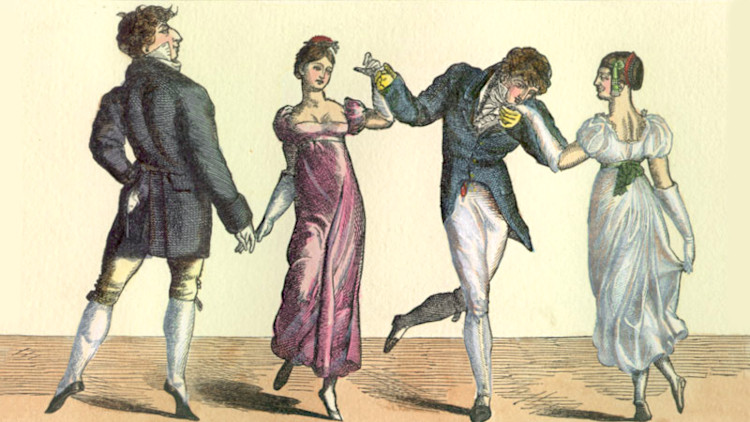
- The First Quadrille at Almack’s from from The Reminiscences and Recollections of Captain Gronow 1810-1860, 1891: Wikimedia (public domain)
- Claire Clairmont by Amelia Curran, 1819: Newstead Abbey via Wikimedia (public domain)
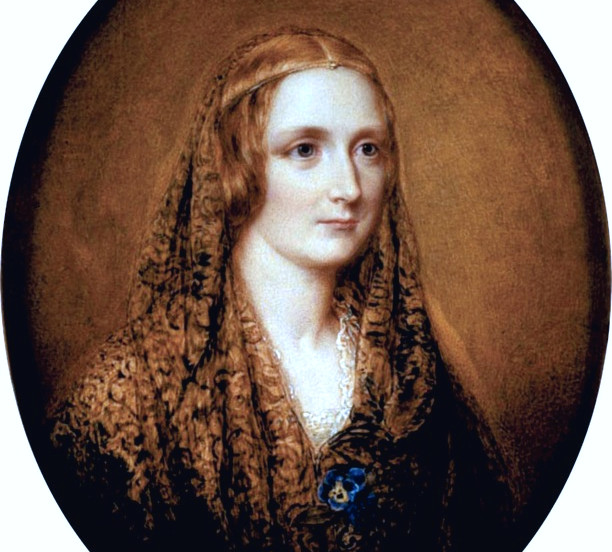
- Posthumous miniature portrait of Mary Godwin, later Shelley, allegedly painted after a death-mask by Reginald Easton, 1857: Bodleian Library via Wikimedia (public domain)
- Allegra, Claire Clairmont and Byron’s daughter: Wikimedia (public domain)
- Posthumous Portrait of Shelley Writing Prometheus Unbound by 1845: Keats-Shelley Memorial House, Rome, via Wikimedia (public domain)
- George Gordon, 6th Baron Byron by Thomas Phillips, 1813: Newstead Abbey via Wikimedia (public domain)


